


The Most Common Mistake Tech Employees Make Before a Liquidity Event


Tara Shulman is a Principal Wealth Advisor at Compound. She has extensive experience guiding clients through IPOs, including Figma, Anthropic, Coinbase, and numerous other tech company liquidity events.
If you’re anticipating an exit event this year, you may hold one equity compensation type or a combination of RSUs, ISOs, and NSOs in your equity package. This manual covers all of your equity options. Click here for our specific manuals on RSUs, ISOs, and NSOs.
If you're approaching a liquidity event, it's time to shift your thinking.
No one can predict what will happen to your stock — and if you focus too much on timing the perfect exit, that can leave you either paralyzed or second-guessing.
Most people in this position are asking “when should I sell it?” It’s a reasonable question.
But it misses the bigger one: Is your company stock still the best place for your money? And how much of your net worth should be tied to a single position given your goals and risk tolerance?
Key takeaways:
• Shift from stock-timing to portfolio allocation.
• Make downside risk concrete through visualization.
• Plan strategically during lockup, and use the plan you’ve already constructed when volatility comes.
Stop Focusing on Maximizing Your Stock Price
A lot of the time, tech employees fixate on maximizing the price of their specific stock. But when they do, they’re leveraging their bets on a pretty all-in outcome.
When your company gives you equity as part of your compensation, you're not just receiving a nice perk. You're actively making an investment decision.
For RSUs, the issuance of the stock — or the vesting of it — is considered an ordinary income event. Like getting paid a cash bonus and then turning around and reinvesting 100% of it into stock.
If you’re juggling ISOs or NSOs, the moment there's a spread between your exercise price and the market price, they become valuable. And you're making an active investment decision about whether to capture that value or hold onto the shares to see if they grow.
The decisions you make when exercising, selling, or holding your stock options, and the timing, matter.
When you think abstractly about liquidity event outcomes, it can be difficult to consider the risks. Sell without a plan, and you could face a surprising tax bill without the proper liquidity. Hold everything and wait, and you're likely putting a high percentage of your net worth in a single company.
You could end up with a concentrated stock position, when your money could have grown more effectively with a diversified portfolio. The 90-day post-IPO volatility period makes the risks even higher.
That’s why modeling possible scenarios can help ensure you’re not too bullish and you’re protected from potential downsides. Concrete visualization is key — seeing the potential pitfalls can really change how you approach risk.
Bet On Your Portfolio, Not Your Stock
The goal is not to predict price movements (like you’re gaming the system), but to optimize your overall wealth for when the best-case scenario doesn’t happen.
For example: You can’t predict if Figma stock will go up or down next quarter. But you can look at historical data and see how an index or how a diversified portfolio — including alternative investments — performs on average over time. Historically, diversified portfolios have seen average annual returns in this range; however, past performance does not guarantee future results.

When you base decisions around diversified portfolio assumptions (like the expected returns and behavior patterns of a balanced investment portfolio), you can make concrete plans to help you meet your life goals and liquidity needs.
With the Figma IPO, the critical question wasn’t “when’s best to sell” — it was whether Figma would still be their optimal investment going forward, or if it would be more advantageous to let some of their money grow elsewhere.
You’ve probably invested a lot of time in helping grow the company, and now it’s going through an IPO: It can be difficult to think beyond its success. But you should, because the right option for you could exist in a more diversified approach.
Make plans around your goals, and the most effective path to reach them, regardless of the stock appreciation.
Make potential losses concrete, not theoretical
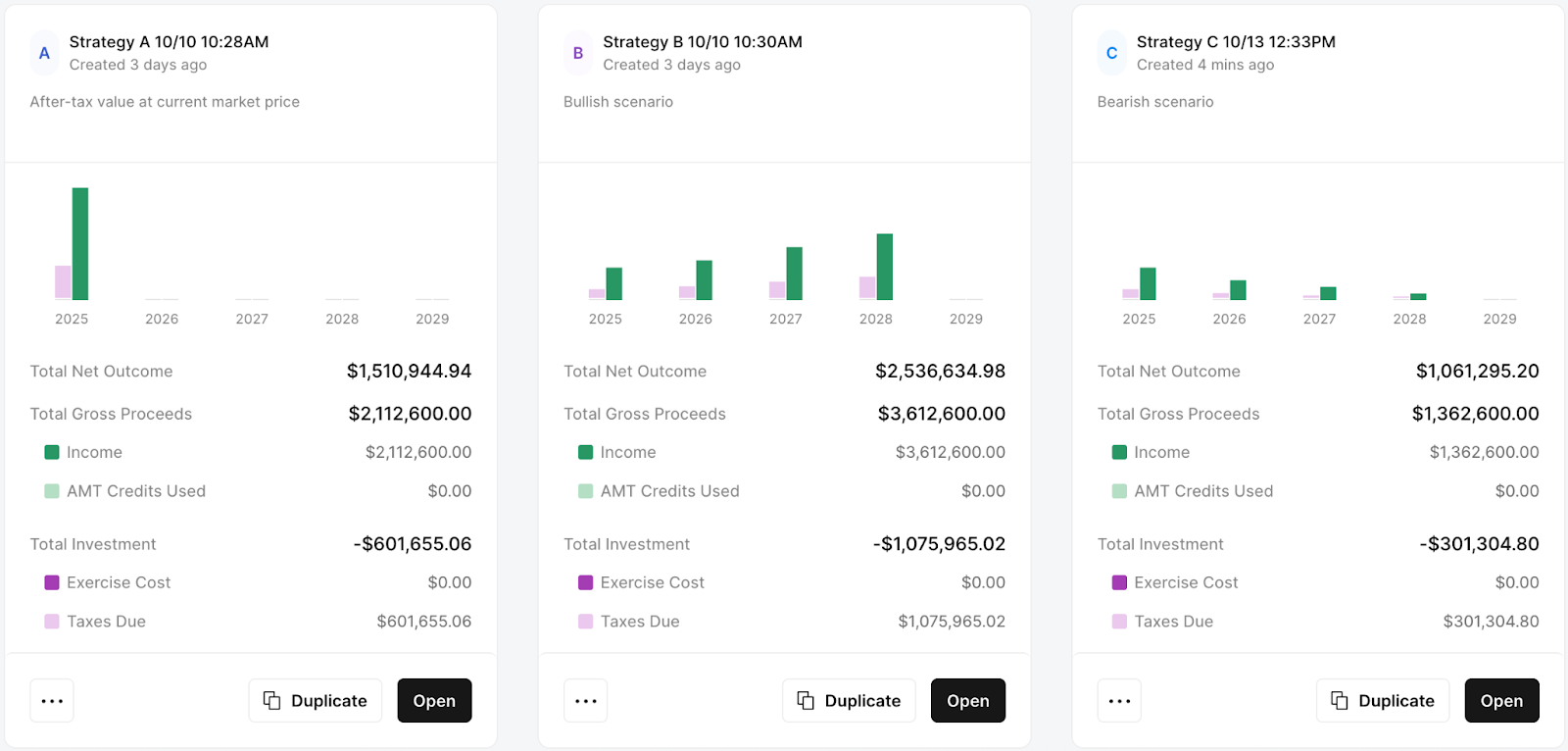
Visual scenario planning can keep you from ignoring potential downsides. When you see exactly what you'd lose if Figma drops 40% while you have a concentrated position — not just hear, "it could be risky" — it fundamentally changes your decision-making.
Tools like Compound's Equity Simulator can help you make downside risk tangible by tying actual numbers to your holdings. Visualizing outcomes can lead to a 10-20% shift in our clients’ strategies, which often leads to more diversification, higher tax withholding, or earlier selling triggers.
Optimize across equity types, not in isolation
Different equity types have different tax treatments and risk profiles. If you’re dealing with more than one, you should speak with your advisor about developing a strategy across the board.
A quick cheat sheet to keep in mind when developing your strategy:
• RSUs are taxed at vesting like ordinary income, which means regular taxes.
• ISOs have AMT allowances that let you exercise some options tax-free, but there’s concentration risk if you hold for capital gains treatment.
• NSOs are taxed like ordinary income when they’re exercised
Your optimal approach depends on your mix of equity types and how they impact your overall financial health, not just maximizing each type independently.
Plan during lockup, execute during volatility
The 90 days following an IPO are usually the most volatile trading period — dramatic price swings can make you nervous and lead to impulsive decisions.
The lockup period before you can sell is your strategic planning window. By having a plan before it ends, you can avoid making emotional decisions when volatility hits.
Start by building a structured selling system: a ladder of limit orders with specific share quantities at different price triggers.
For example: You might set up a ladder that sells 100 shares when the stock reaches $100, another 100 shares at $110, and so on.
Determine your limits by working backwards: Work with your advisor to decide how much money you need to be comfortable or to meet certain goals. Then calculate what share quantity at what price makes that possible. That’s your first limit order.
Your advisor can help you define your implementation details: the quantity of shares to sell at each price point, your floor price, and the type of limit orders that protect you from panic-selling or putting your portfolio at risk.
That way, when volatility hits and the stock swings 20% in a day, you know what action you should take. You can execute on the plan you’ve established instead of making reactive decisions.
The best time to build your plan is before trading opens, not after. Make sure to meet with your advisor regularly leading up to each selling window to reevaluate your strategy and selling triggers, and plan for any tax obligations, so withholding happens when you can sell shares to cover the bill.
Your Stock is Just One Piece of the Puzzle
When you're facing any kind of liquidity event, you should consider your risk tolerance, the tax implications, your goals, and your biases, because no one knows how the stock will perform.
The easiest thing to do is nothing — but that leads to a concentrated risk position that might not work in your favor.
Developing a plan before your selling window opens — one that accounts for your full mix of equity types, your tax situation, and your goals — is how you avoid making a million-dollar decision under pressure.
FAQs
When is the best time to sell my company stock after an IPO?
Instead of trying to time the market for the perfect sale price, focus on whether your company stock is the best place to invest your money. While you can't predict your specific stock's movement, you can reasonably expect a diversified portfolio to return 7-10% annually based on historical data. During the lockup period, you can create a systematic selling plan that accounts for your liquidity needs and goals.
How do I balance holding my company stock for potential upside while protecting against losses?
Use visual scenario planning (like through Compound’s Equity Simulator) to make potential downsides concrete, not theoretical. When you see the actual dollar amounts you'd lose if your stock drops 40% while you're still concentrated, it has the power to ground your decision-making and help you build a strategic plan.
Do I need to think about my RSUs, ISOs, and NSOs differently?
Yes — but you should coordinate your strategy across all of the equity you have instead of optimizing each independently.
–
Armed with a dashboard that shows your full financial picture and expert advice from our advisors, we can help you move from reactive IPO planning to a strategic plan for building your wealth.
Connect with a member of Compound’s advisory team to chat more about your options and try out the Equity Simulator Tool.