


Why High-Net-Worth Investors Are Underinvested in Alternative Investments
.jpeg)

Steve Dean is the Chief Investment Officer at Compound. He has 30+ years of experience in markets and investments, and leads our investment team , developing our public and private model portfolios. He previously worked in the economic research department of the Federal Reserve.
“Access to alternatives.”
You’ve probably seen that offered all the time — but what does it actually mean?
I’ve seen a pattern for years: RIAs across firms advertise access to alternative investments, and clients nod along. Then, they move on and miss an opportunity.
It’s well documented that most investors — even highly qualified ones — allocate under 5% of their wealth to alternatives. Not because they don’t understand alts, but because they just don’t know where to start.
My colleagues and I typically help high earners get closer to 20–40%.
Getting there starts with changing how you think about alternatives. Many investors treat them as a product category — something to pick from — when they should be treating them as a key component of how they build their portfolio
I’ve spent decades documenting market changes and working with advisory teams on how to incorporate alternative investments into portfolios for high-net-worth individuals. I’m sharing my framework for how to increase your alternative investments allocation, and the three questions worth asking before you do anything else.
Key takeaways:
• Access doesn't mean appropriate. Just because alternative investments are available to you doesn't mean they're the right fit. Each type — private equity, private credit, real estate, others — carries a completely different risk, liquidity, and return profile.
• Alternatives have three distinct jobs. Think of alts along these dimensions: growth (private equity), income (private credit), and diversification (all of the above). Knowing which of those you actually need is the starting point.
• The full picture is everything. Alternatives decisions made in isolation are incomplete. You need a holistic view of your balance sheet — all your accounts, equity compensation, real estate, and outside investments — before deciding how alts fit in.
Available ≠ Appropriate
Just because you can do something doesn’t mean it’s right for you.
Alternatives are marketed as a premium feature, but no one’s talking about what that really means. RIA websites say "access to alts." But which ones? For whom? How much?
“Alternative investments” can mean a lot of things:
- Private credit
- Private equity
- Venture capital
- Private real estate
- Farmland
- Oil and gas
But each of those categories come with different risk, return, liquidity, and tax profiles. They couldn’t be more different.
Saying all alternative investments are the same is like saying stocks and bonds are the same.
Part of what keeps people from acting is that alternatives are genuinely harder to get information on. For many, there’s no ticker, no daily price, and no place to just look them up. The structures are less familiar and the information is less accessible, so most investors end up on the sidelines even when they shouldn’t.
But that opacity is also a real reason to approach alternatives carefully, instead of avoiding them. Most high-net-worth investors may be more concentrated than they realize, and alternatives can be one of the few ways to build a next level of diversification into a portfolio.
The right ones for your portfolio depend on things that aren't visible from the outside — your liquidity needs, what you already own, what's actually missing. That's the conversation worth having before you do anything else.
3 questions to decide which alternative types work for you
Most investors approach alternatives by asking what looks interesting or what their peers are doing. The better starting point is what’s missing from your portfolio and what gap alternatives could fill.
These are three questions you should ask yourself — and discuss with your advisor — to help develop that plan:
1. What are your liquidity needs?
This is the danger zone: Often, investors go off track because they follow their instincts and overstate how much liquidity they need. They end up holding onto money that could be working harder for them.
A qualified purchaser — someone with $5M or more in investments, excluding their primary residence — doesn't have the same liquidity pressure as someone who’s earlier in their wealth accumulation. They can tolerate longer lockups and, because of that, they can access more flexible alternative investment structures.
Even if you’re not a qualified purchaser, the liquidity question still applies. The difference is that with fewer investable assets, the margin for error is smaller. So being honest about what you actually need versus what you think you need matters even more.
2. Are you growth-oriented or income-oriented?
If you're younger and still accumulating wealth, you probably don't need your investments for income. Income-producing investments like private credit could actually work against you, because of how it’s taxed. In this scenario, your focus could instead be on growth.
If you're nearing or in retirement, that’s when income matters. You need your portfolio to generate steady, reliable cash flow. Private credit could work for you because it pays monthly or quarterly distributions at higher yields than traditional fixed income.
But even if you're growth-oriented and don't need income, having some income-producing investments that move differently than your growth assets still makes sense: Those assets may hold up better when equity markets are down. They’re your downside protection.
We map alts on the same growth/income spectrum as public markets. But with one important dimension that applies across both: diversification. Whether you’re growth-oriented or income-oriented, having assets that behave differently from everything else you own helps protect your base.. For many high-net-worth investors, one position could represent most of your wealth, and that can create real risk across your entire net worth.
Determining Your Positioning
Growth (PE or VC)
• Who it’s for: Investors with a longer time horizon and/or those with concentrated equity positions looking to diversify
• Typical return/yield: Historically outperforms public equities over the long run; can be a long wait before gains are visible.
• Liquidity: Illiquid by design — traditional lockups run 7–10 years.
Income (Private Credit)
• Who it’s for: Investors in or near retirement who want higher yields than public bonds and are willing to accept less liquidity in exchange.
• Typical return/yield: Monthly or quarterly distributions, currently running ~7–10% annually.*
• Liquidity: More accessible than PE, but not tradeable like a bond. Some funds offer possible monthly or quarterly liquidity windows; others are longer-term commitments.
Diversification (Real Assets, Non-Equity Alternatives)
• Who it’s for: An investor seeking portfolio stability, downside protection, or exposure to assets uncorrelated with their other holdings.
• Typical return/yield: Lower return profile than pure equity by design. It may not fall as far when equities sell off, which can protect your base.
• Liquidity: Varies widely. Non-traded REITs and interval funds may offer quarterly liquidity windows. Direct real estate investments are highly illiquid.
Disclosure: Past performance is not indicative of future results. There is no guarantee that private equity will outperform public markets in any given timeframe.Diversification and downside protection strategies do not ensure a profit or protect against loss in declining markets.
* Figures represent gross target yields. Actual returns will be reduced by management fees, incentive allocations, and expenses. Private credit involves risks of principal loss (default) and limited liquidity. Floating-rate structures may increase borrower default risk in high-interest environments
So what are private equity, private credit, and real assets/non-equity alts for — growth or income?
Private equity (a “growth-oriented” strategy): For long-term capital appreciation through ownership stakes in private companies (think of it as the private counterpart to owning stocks). Historically it has outperformed public equities over the long run, though recent years have been more challenging as exits have taken longer to materialize. Typically, no income distributions and attractive to investors with more flexible liquidity needs.
Private credit (an “income-oriented” strategy): To generate regular cash flow through private lending (think of it as the private counterpart to owning bonds). It can act a lot like fixed income with monthly or quarterly distributions and appeals to investors who need steady income (and are fine with paying the taxes).
Private real estate (somewhere in between): It can become income-producing (like an REIT paying distributions) but also hold growth potential from appreciation in the value of the property.
Non-equity alts (a “downside-protection” strategy): To reduce portfolio volatility by investing in assets that move differently from both public and private equities. Even for a growth-oriented investor, non-equity alternatives can help offset downside if equities fall.
3. What does the full picture look like, and what's missing?
In order to plan and structure your portfolio efficiently, you need to have a holistic view of your finances. And chances are, right now your investments are spread across your brokerage, a mortgage, your company RSUs, maybe a trust. And none of those pieces talk to each other.
That makes it hard to see the story of your life and how changes in one part affect the other: What happens if your company fails? If you lose an income stream? You can’t effectively consider your entire financial picture.
The most important part about dipping into alts is making sure the strategy you choose works for your specific situation, goals, and financial needs..
By clearly understanding what your long-term and short-term financial goals and needs are, you can better identify where alts fit into your picture.
To see your full financial picture — including the assets that don't show up in a standard brokerage account, like equity compensation, private investments, and real estate — Compound's dashboard helps high earners create that big picture view..
You can see what percentage is accessible, locked up, at risk, growing, and so on by signing up here. And on the advisor side, this holistic view makes conversations about your priorities easier, whether you’re growth or income-focused.
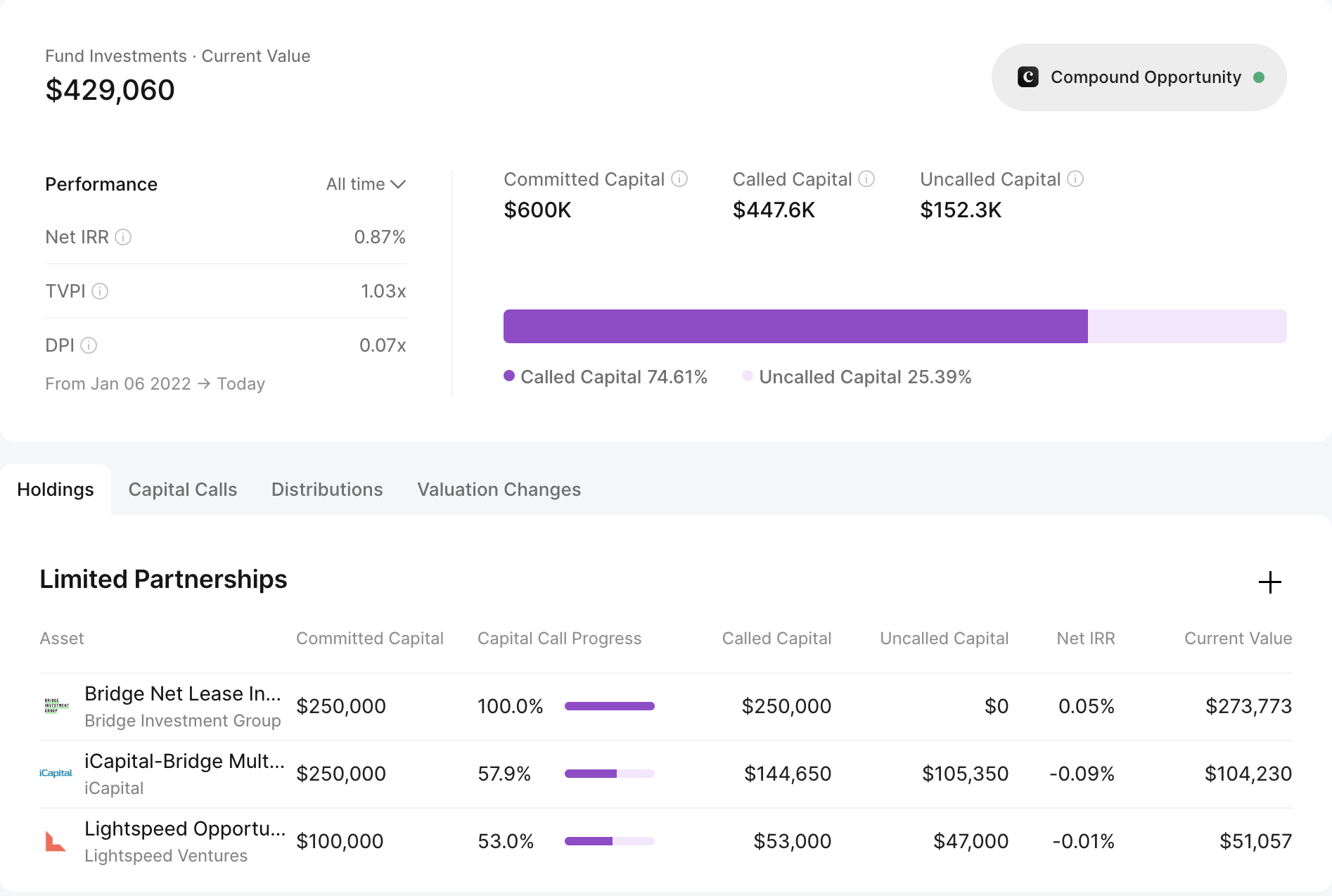
What Compound’s Unified Dashboard Can Do
• Identify how many shares in a stock you have across your entire balance sheet
• Aggregate external accounts (outside brokerages, private equity and VC fund investments, angel investments, real estate, company equity, crypto, and physical assets)
• Highlights gains, cost basis, and performance for Compound investment accounts
• Create a clear picture instead of delivering data overload
Say you work at a software company, hold company RSUs, and are considering private equity — and you’re already very concentrated in tech markets.
You shouldn’t ask: “Do I want PE alternatives?”
You should ask: “What’s missing that could help diversify my situation?”
The answer probably isn’t more of the same investments. It’s likely something that moves differently, and that’s a very different conversation than just picking what looks interesting.
We’re Seeing the Democratization of Alts
Traditionally, investing in alternatives meant accepting a clear tradeoff: lock up your capital for 7-10 years in exchange for access to exclusive investments and their potentially stronger returns. But private companies are staying private longer than anticipated, and exits aren't materializing on the timelines investors expected. The goalposts moved.
→ When I started in finance, a lot of funds had $1M minimums, and accreditation requirements were extremely strict.
→ But now, to adjust for those timelines, access is a lot easier. Some funds have very low or no minimums, and are available to investors with lower accreditation requirements, and a growing number of funds offering the possibility of limited quarterly liquidity windows instead of 10-year lockups.
The secondary market has also changed — qualified purchasers have new tools for navigating the frustrating reality of private companies that are staying private longer than anticipated. Plus, funds are offering limited liquidity windows after year three, buyback structures, and secondary market access.
Although the private markets are becoming more accessible, that doesn’t mean you should dive in headfirst.
As alts democratize, some may start to act more like public markets. They’re subject to emotional selling, forced redemptions, and the volatility that lockups were designed to prevent.
This is why the “fit” question is so important when you choose alternative investments.
5 principles for your alternatives approach
- Alternatives are portfolio architecture, not product selection. Don’t ask yourself which alt fund you should pick — ask yourself what function each alt serves in the context of your entire portfolio. Every decision should start with "what am I missing?" not "what looks good right now?"
- Liquidity risk is real, but so is over-liquidity risk. Most investors have more liquidity than they actually need, so they don’t take advantage of potentially better-performing, but less liquid structures.
- The third dimension is diversification, not just growth or income. An asset doesn't need to produce high returns or high income to earn its place in a portfolio. If it moves differently than everything else you own, it can have great value — especially in volatile periods.
- Accreditation is a filter. The qualified purchaser tier ($5M+ investable assets) unlocks the most sophisticated, typically longer-lockup structures. But the framework for thinking about alts applies across accreditation levels — what changes is access. Logic stays the same.
- The full picture matters. Alternatives decisions made without full visibility into your wealth profile — including employment concentration, real estate, equity compensation, and outside accounts — are incomplete.
Where do alts fit into your current portfolio?
FAQs
How much of my portfolio should be in alternative investments?
The industry generally suggests 20–40%, yet most investors allocate less than 5%. The right number depends on your specific situation — your liquidity needs, whether you're oriented toward growth, income, or diversification, and what gaps exist in your current portfolio. There's no universal answer, which is why starting with "what's missing?" matters.
What’s changed as far as alternative investments opportunities?
Minimums that once started at $1M have dropped significantly, accreditation requirements have eased, and interval funds now offer the possibility of limited quarterly liquidity windows instead of decade-long lockups. That said, more access doesn't automatically mean more suitability — as alts become more democratized, they can start behaving more like public markets, which undermines some of their original advantages. Fit still matters.
How do I know which type of alternative investment is right for me?
How much liquidity do you actually need? Are you prioritizing growth, income, or diversification? And what does your full financial picture look like? Private equity, private credit, and real assets each serve a different function, and the right choice depends on what role you need filled in the context of your entire portfolio.